Global electric circuit
The atmosphere behaves like a leaky capacitor, with the ground and the ionosphere as its two plates and thunderstorms as the battery. My PhD built a model of that circuit inside a full community climate model.
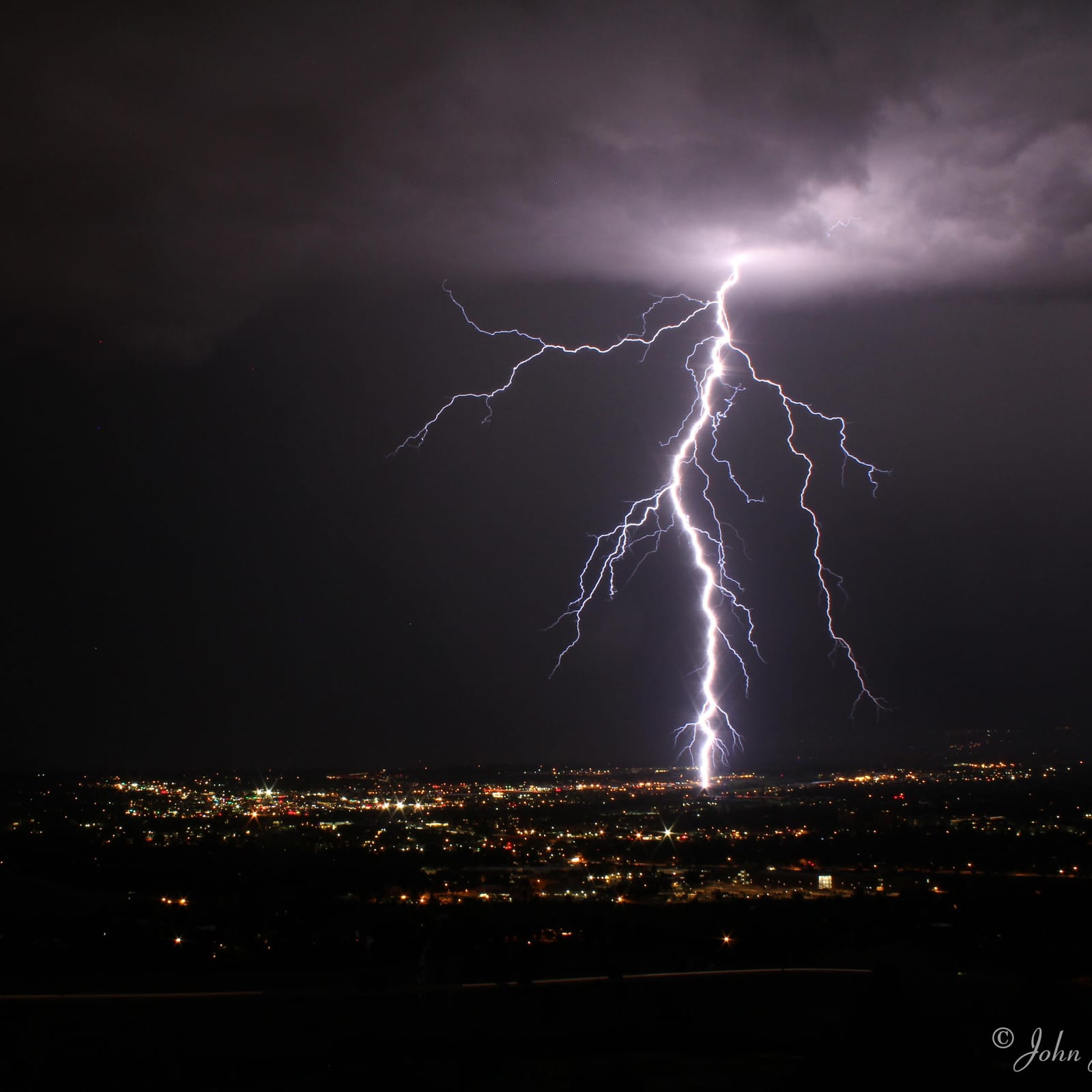
The global electric circuit (GEC) investigates the electrical connections within Earth's atmosphere. Its responses split into two regimes: strongly time-dependent AC behaviour — lightning, transient luminous events, and the VLF and ELF signals they radiate — and the slowly varying DC behaviour that my research addresses, where the atmosphere acts as that leaky capacitor.
To model how clouds affect the electrical response of the system, I used a finite element package to simulate a range of cloud parameters; that work appears in Atmospheric Chemistry and Physics.
WACCM-GEC: the model
Rather than prescribe an atmosphere, I incorporated the conductivity and source-current work into the Whole Atmosphere Community Climate Model. Letting a climate model solve the complex atmospheric forcing terms means the GEC currents and electric fields can be solved on a genuinely realistic atmosphere. The full description of this framework is published in JGR: Atmospheres, and the work was selected for a research spotlight in Eos.
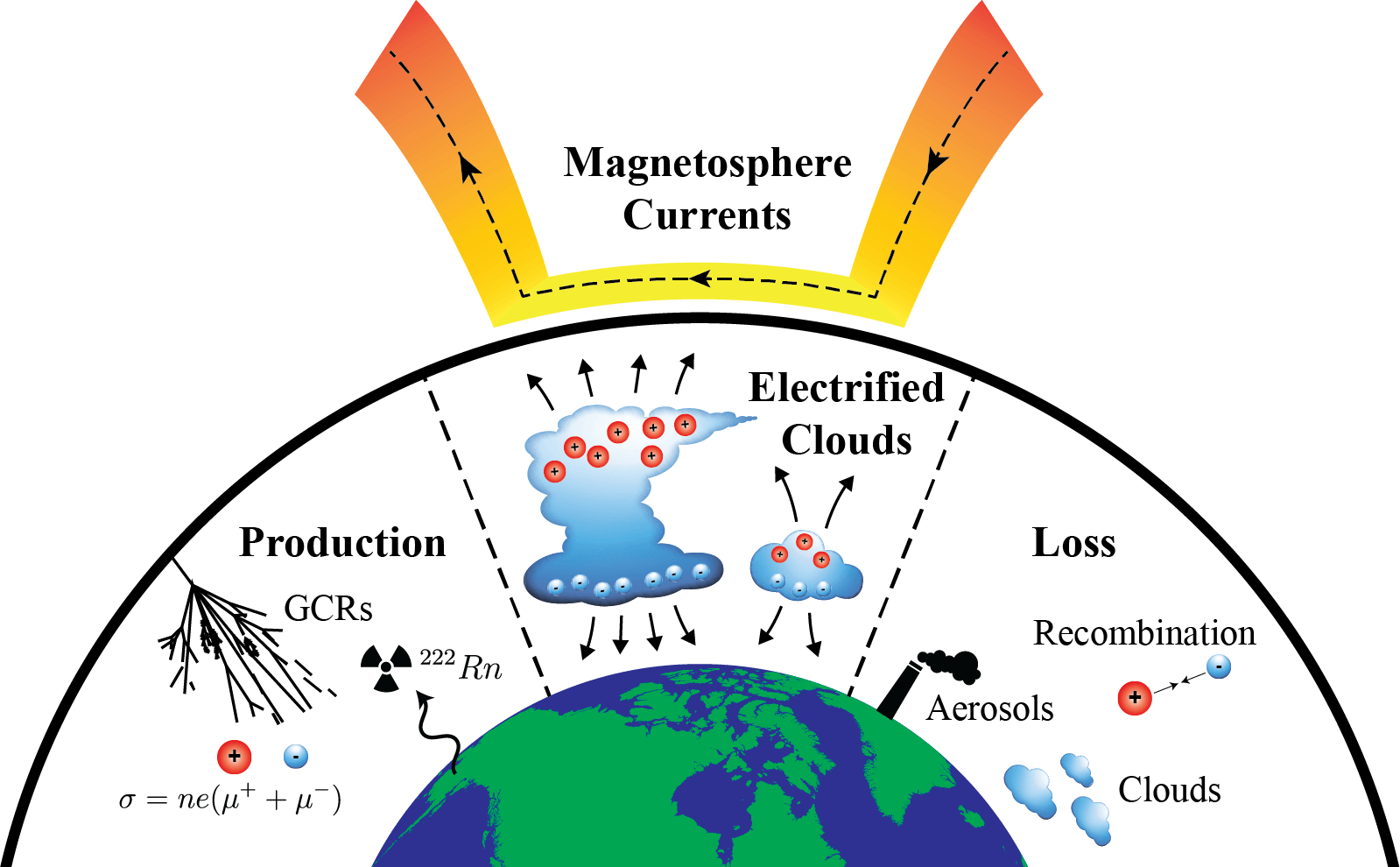
Conductivity
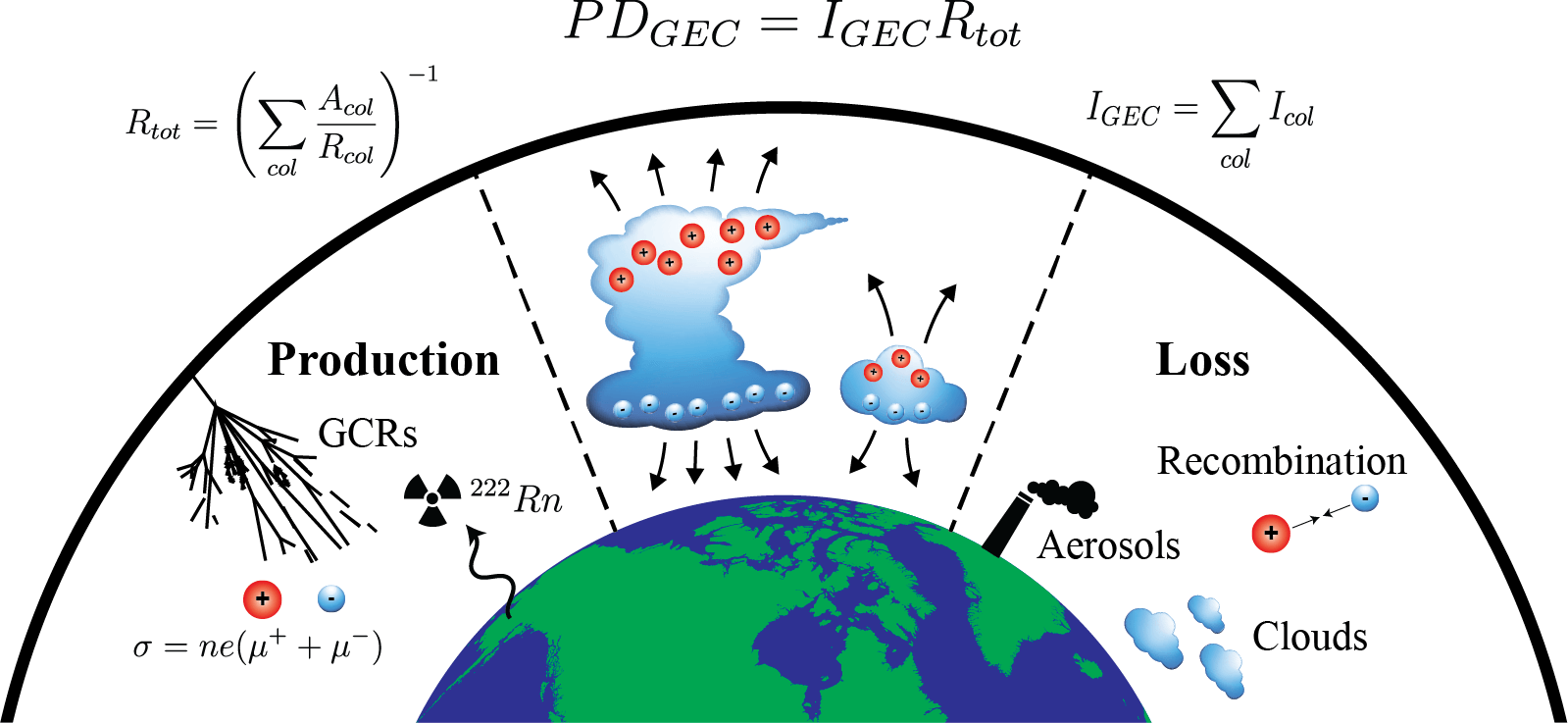
WACCM-GEC follows the methodology of Baumgaertner et al. (2013) to generate the production and loss of ions — radon, galactic cosmic rays and solar proton events — which together determine atmospheric conductivity. Baumgaertner et al. (2014) is used to model the loss of ions to attachment on water droplets inside clouds more accurately. With conductivity known everywhere, the total resistance of the atmospheric column follows.
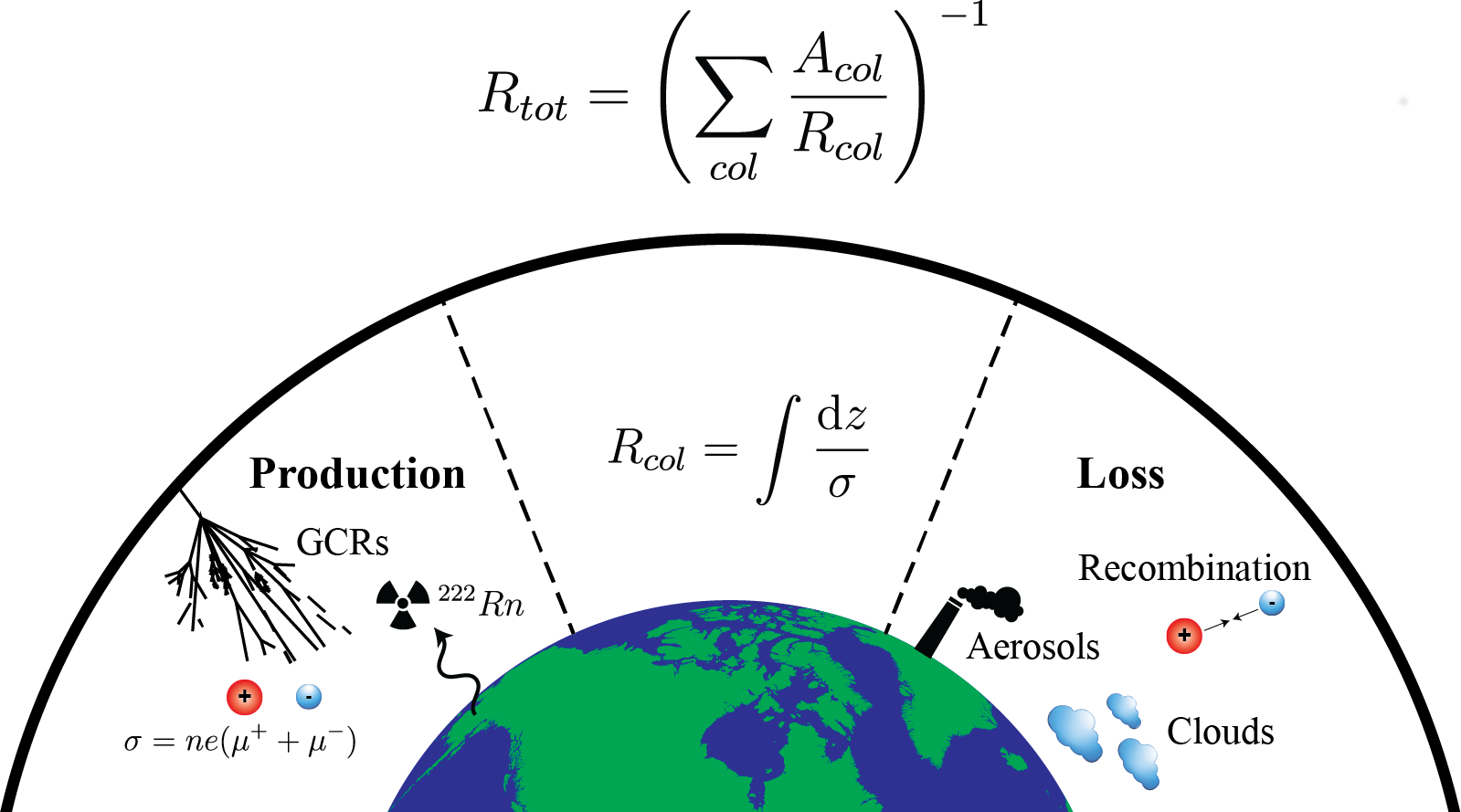
Sources
Current in the GEC originates in electrified clouds. The strength and location of those storms is captured well by the updraft mass flux the climate model produces, which is used to parameterize the total current in each atmospheric column — and from there, the total current flowing through the whole domain.
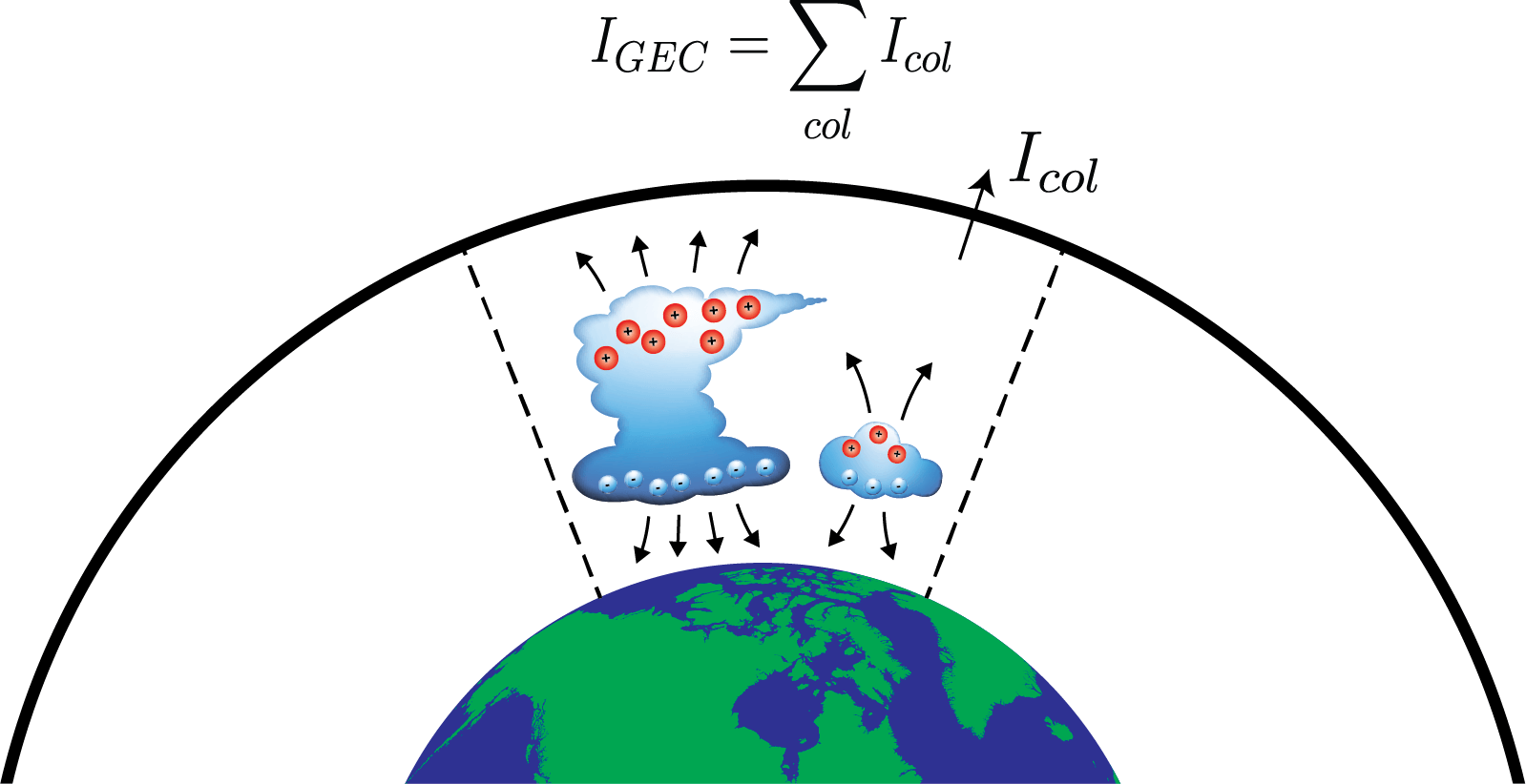
Top potential
The total current and total resistance together set the highly conductive ionosphere to a different potential from Earth's surface. The resulting potential difference varies with the conductivity and source distributions across the domain.
Magnetospheric currents
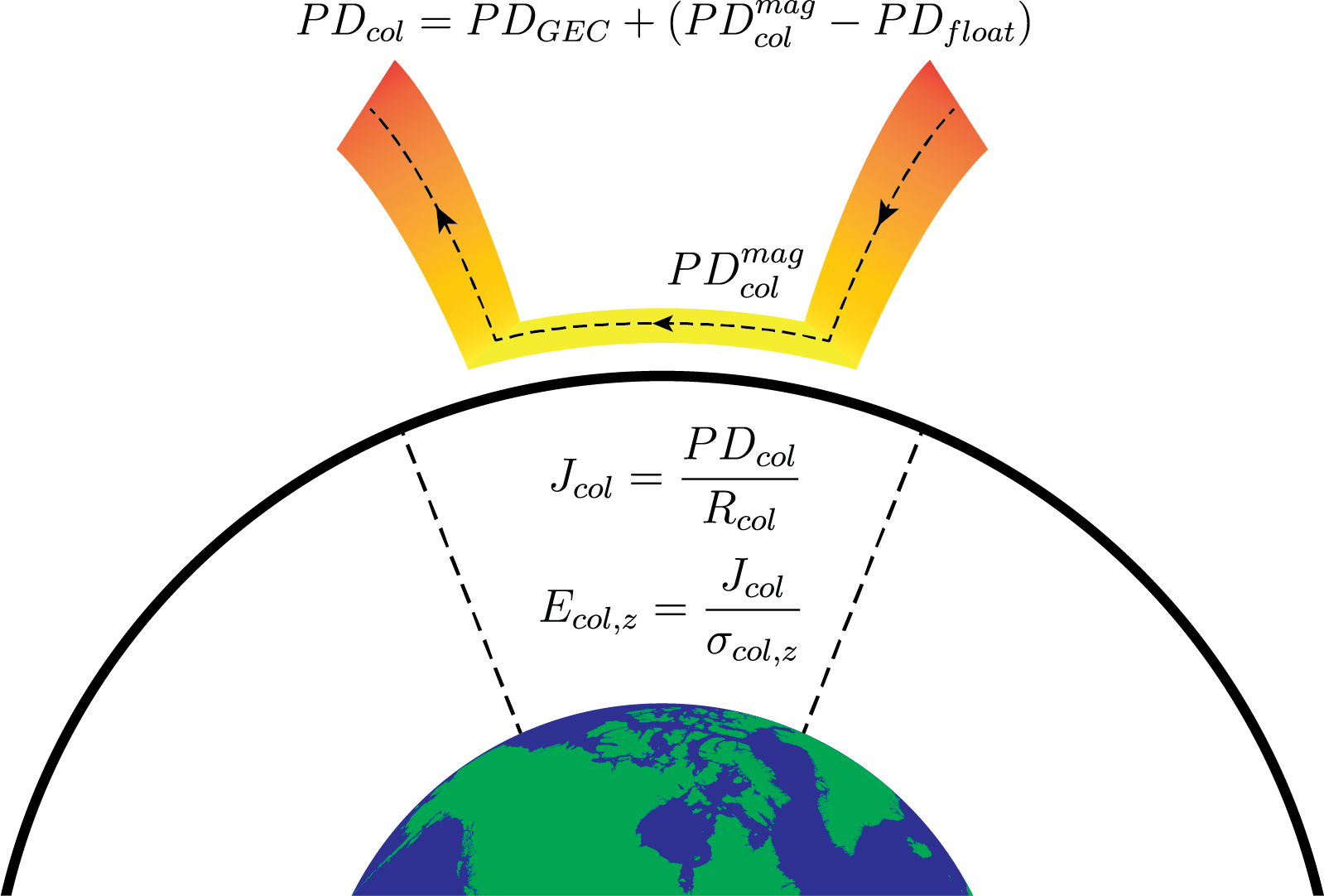
Currents flowing in the ionosphere and magnetosphere are external to the GEC, but they impose large-scale potential patterns on it — strongest at high latitudes near the geomagnetic poles. WACCM-GEC modifies the potential difference above each column by these magnetospheric perturbations self-consistently, so no leakage current flows between the two systems. Once each column's potential difference is set, the current density and electric field at every point in the atmosphere follow.
Results
These conductivity and source calculations produce fair-weather currents and electric fields, and because the host is a community climate model, the surface electric field varies realistically over time. Below, modeled surface electric fields at two Antarctic stations — Vostok and Concordia — are compared against observations.
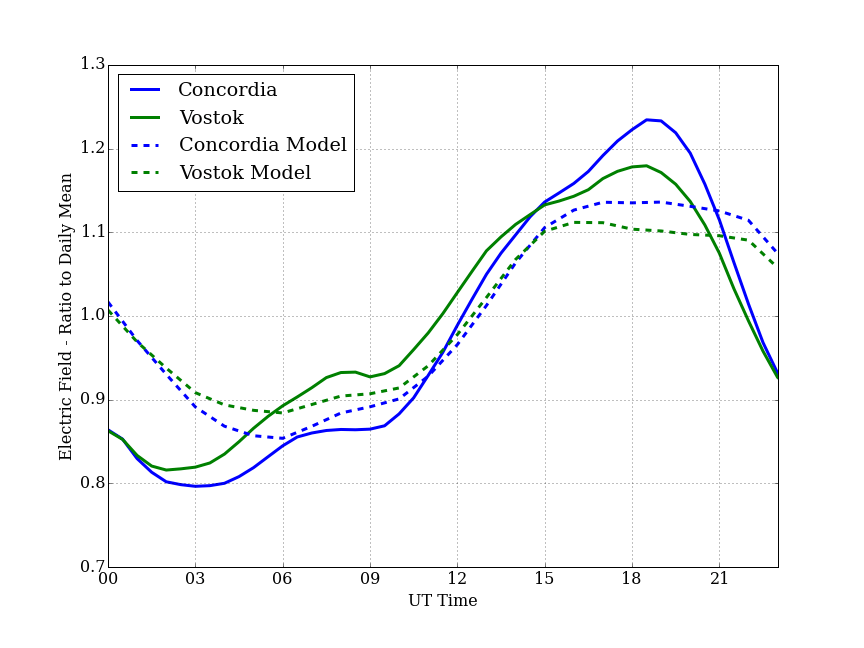
The model reproduces the diurnal signature in universal time and captures the distinct phase offset between the two sites, which arises from the imposed high-latitude magnetospheric potential pattern. Differences remain — notably the amplitude of the deviations, which depends on source strength and is an ongoing area of investigation. WACCM-GEC exists so the community can test coupling mechanisms between atmospheric processes and the global electric circuit in a physics-based model that is open to everyone.